
What Is a Simple Starting Framework for AI Without Becoming a Tech Expert?
Where Do Most Family Business Owners Get Stuck Before They Even Open an AI Tool?
Most owners stall before they've touched a single tool, not because the technology is hard, but because they're trying to solve the whole business at once instead of choosing one small, safe place to begin.
You've built decades of judgement no software can replicate, the read on a client's hesitation down the phone, the knowledge of which supplier always comes through under pressure. None of that shows up in a demonstration video, which is part of why AI can feel like it belongs to someone else's business. The gap isn't competence; it's time, and the worry that admitting you haven't started yet means admitting you're behind. Here's what matters before you open any AI tool at all.
What Do You Need to Know Before You Touch a Single AI Tool?
A simple starting framework for AI means picking one repetitive task to automate first, building your own comfort with it before anyone else touches it, and protecting the judgement and relationships that already make the business run, rather than attempting a full digital overhaul in one go.
Start with one task, not the whole business.
Your own comfort comes before team-wide rollout.
Capture institutional knowledge before it retires with you.
Small, sequenced wins beat one big overhaul.
Why Does Falling Behind on AI Feel Like a Personal Failure?
Your hesitation around AI isn't a skills gap, it's a stability instinct: protecting a business that already works from a change you haven't had the time to properly vet.
When you've spent thirty years holding the operation steady, admitting you don't understand a new system can feel like admitting you're no longer the person everyone can rely on. That fear rarely gets said out loud. It just shows up as delay, another month where the AI conversation gets pushed to next quarter.
The business picks up on that uncertainty too, and when the person at the top is privately unsure, technology decisions stall and the team takes its cue from your hesitation. Stability doesn't come from mastering every tool yourself, it comes from being honest about where you're starting from. Left unaddressed, that honesty gap starts showing up in specific, easy-to-spot habits.
Which Habits Quietly Keep Family Businesses Running on Memory Instead of Systems?
Watch for the process that only works because one person remembers every exception, and the new hire who gets trained by shadowing someone for weeks instead of following anything written down.
Look at how a quote really gets built in your business: is it in a system, or is it in your head and maybe one senior staff member's? Check whether pricing adjustments, loyal-customer discounts, and supplier workarounds exist anywhere except memory. If the answer is nowhere, that knowledge walks out the door the day that person does.
Notice too how often "we'll sort it later" gets said about anything involving AI or automation, while every other operational fix gets prioritised immediately. The longer the business runs purely on memory and relationship, the harder succession becomes, because there's nothing written down for anyone to genuinely take over.
How Fast Is AI Adoption Moving Among Small and Family Businesses?
Generative AI use among small businesses has more than doubled in two years, which means the businesses waiting for things to settle down are simply waiting for a trend that keeps accelerating.
According to the U.S. Chamber of Commerce's 2025 small business survey, reported by the Lexington Institute, 58 percent of small businesses now use generative AI tools, up from 40 percent in 2024 and just 23 percent in 2023. That's the fastest uptake the Chamber has tracked since the rise of social media. For a family business, that pace matters less as a race to win and more as a signal of what everyone else is already quietly trying.
It also means the knowledge gap you're worried about isn't a personal failing, it's where most owners in your position currently sit. What separates the businesses pulling ahead isn't technical skill, it's structure: a clear, contained way of trying one thing before expanding to the next.

How Can a Family Business Build AI Confidence Without Chaos?
Structure comes before software: get personally steady with one small AI use first, and the rest of the rollout stops feeling like a gamble.
Most AI rollouts fail in family businesses not because the tool is wrong, but because it lands inside a system still carrying unresolved hesitation and half-written processes, with a founder quietly unsure she's allowed to not know something yet. Fixing the technology first, before fixing that internal footing, just builds a shinier version of the same uncertainty.
This is where Macro Momentum's Secure Foundations™ principle earns its place, even in something as practical as AI. It starts with personal readiness before collective change: safety to experiment without judgement, enough emotional regulation to try a tool without panic when it doesn't work first time, and clarity about the one process you're testing right now. Without that groundwork, a team rollout collapses into confusion the moment something goes wrong.
The same logic that works for strategic planning works here. (Couplepreneurs, Chapter 1) argues that a documented, inclusive plan, built around clear goals and shared ownership, makes problems easier to solve when they inevitably show up. Apply that to AI: pick one process, write down what success looks like, and build from a position of steadiness rather than scramble.
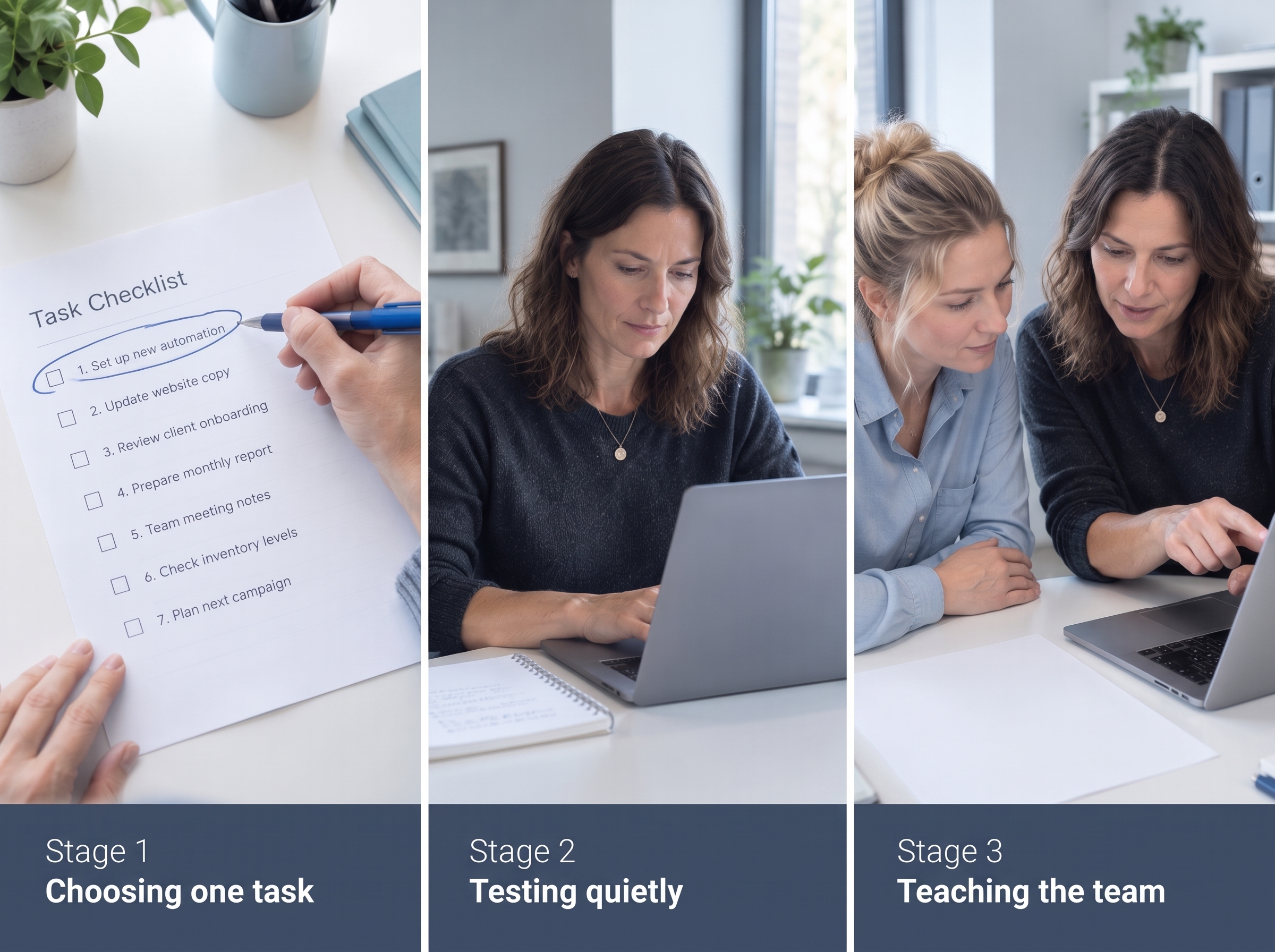
What Are the Three Stages of Introducing AI Into a Family Business?
This isn't a six-month digital transformation. It's three deliberate moves that keep the business steady while one small part of it changes.
Naming the One Task Worth Automating First
Pick a single repetitive job, like drafting quotes or scheduling follow-ups, and leave everything else exactly as it already runs.
Running It Quietly Before Anyone Else Notices
Test the tool yourself for a few weeks, adjust it privately, and only involve the team once it genuinely works.
Teaching the System Back to the Team
Show one trusted staff member how it works, document the process in writing, and widen use only once it's proven itself.
What Changes Once AI Has a Clear Place in the Business?
You get hours back from the task you automated, and something harder to measure but just as real: proof to yourself that modernising the business doesn't require becoming someone you're not.
Owners who start this way typically report getting hours back each week from the one process they automated first, whether that's drafting correspondence, chasing invoices, or sorting enquiries. More importantly, decision-making speeds up because there's one less manual task competing for attention during the busiest part of the day.
The bigger shift is quieter. Once you've proven you can learn one new system on your own terms, the embarrassment about the knowledge gap tends to fade, replaced by something closer to ownership. That confidence travels into succession planning too, because a business with some of its knowledge finally written down is a business that's easier, and safer, to hand over.
What Do Family Business Owners Most Want to Know About Starting with AI?
Here are five honest answers to the questions that come up fastest once owners stop pretending they already know.
Do I need to understand how AI works first?
No. You need to know what one task you want it to do, and give yourself room to test it before judging it.
What if my team resists using it?
Introduce it quietly yourself first, so you can show proof it works rather than asking for blind trust.
Is it too late if I'm only starting now?
No. Starting with one contained task this month still counts, and still protects the knowledge you haven't captured yet.
How do I know which task to automate first?
Pick whatever repetitive job eats the most time without needing your personal judgement to complete it.
Will this replace the relationships my business runs on?
No. It should free up time for those relationships, not replace the judgement that built them.
Who Keeps This AI Framework Moving Once the Business Day Takes Over?
Most owners can start this alone. Fewer can keep it going once invoices, rosters, and family conversations crowd the calendar again, which is exactly where outside structure earns its keep.
Macro Momentum works alongside family business owners on exactly this problem through our AI advisory pillar, choosing the one process worth automating, setting it up with proper privacy and risk settings, and coordinating the team rollout once it's proven. We're not here to turn you into a technologist. We're here to make sure the stability you've spent decades building doesn't get traded for a tool nobody fully trusts.
Where Does Your Family Business Land a Year After This First Step?
Picture the version of your business a year from now where one process runs itself quietly in the background, where the knowledge that used to live only in your head sits somewhere your successor can genuinely find it, and where you're no longer privately embarrassed about a gap that most owners your age are still closing too. That's not a technology outcome, it's a stability one, built one contained task at a time. Macro Momentum works with family business owners to build a simple starting framework for AI that protects what you've already built while you test what comes next, and a conversation at https://macromomentum.com/ is where that first task gets mapped out properly.